
Goal Setting When You’re In the Middle of the Story
Before we talk about goals, we need to talk about the middle. Today isn’t about fixing everything. It’s about being honest about where you are, remembering why you started, and choosing one clear next move forward.
The In-Between Is the Hard Part
Starting feels exciting.
Being established feels validating.
The middle feels messy, quiet, and uncomfortable.
The middle is where:
You’ve already changed, but your life hasn’t fully caught up yet
You’re managing your old responsibilities while building something new
You’re holding two identities at the same time
The middle phase feels uncomfortable, overwhelming, or even annoying (for the impatient ones like me).
It’s the transition.
The Line Story Exercise
Grab a piece of paper (or notes app or a design app).
Draw a long horizontal line.
This line is your story.
Label:
Left: Where I Was
Right: Where I Want to Be
Leave the middle blank for now.
or use bullet points in notes:
Where I was
Where I am Now
Where I want to be
Before we start, make sure to write what’s true, not what sounds impressive. Free flow journal, just flow.
The Beginning:
Where I Was
“Once upon a time, there was a version of me who decided to try something new.”
Write about:
Who I was back then
What I was tired of
What I quietly hoped would change
What I didn’t know yet
Examples you might think but don’t need to write perfectly:
“I was burnt out and didn’t want to dread Mondays anymore.”
“I wanted flexibility but had no idea how people actually made money doing this.”
“I didn’t feel confident, I just felt restless.”
The End:
Where I Want To Be
Move to the right side of the line.
“One day, this version of me wakes up and something feels different.”
Write about:
What feels lighter or calmer
What feels more stable
What a normal day looks like
What problem is no longer taking up so much space
Examples:
“I’m not guessing what to charge anymore.”
“I know how long things take me.”
“I don’t panic every time a project ends.”
The Middle:
Where I Am Now
Come back to the line. Place a dot where you feel you are today.
Or if you’re using your Notes app, add space to show where you feel.
Where I was
Where I am now
Where I want to be
“This is the chapter I’m in…”
Answer:
What do I know now that I didn’t before?
What feels harder than I expected?
What progress do I forget to count?
What still feels unfinished?
The Middle also includes your old life…
write down what you’re still managing from your previous chapter:
A full-time job
Financial pressure
Family responsibilities
Burnout from a past career
Old expectations of yourself
Fear of disappointing people
“For me, the hardest part of changing isn’t learning something new. It’s managing my old life while trying to build a new one.”
The middle can feel uncomfortable and you get to move forward in a way that makes sense for you.
Quick Share
If you want to share, tell us:
Where you placed your dot
Or one thing you’re managing in the middle
Turning the Middle Into a Goal
Now we choose a goal.
This goal is not for the ending version of you.
It’s for the version juggling real life and change at the same time.
“My current chapter needs ______ most.”
Examples:
Momentum
Proof
Structure
Stability
Fewer open loops
Then:
“In the next 90 days, I will ______ to support this version of me.”
Examples:
Publish my portfolio site
Finish two case studies
Book one Squarespace client
Apply what I’ve learned to one real project
If this goal belongs to the future version of you, it’s too big.
Bring it back to the middle.
Goals for Money
(Rates and Runway)
Part of supporting yourself in the middle is clarity around money.
Setting realistic rates for 2026
Reverse-engineering income goals into monthly client targets
Making sure your 90-day plan matches your actual capacity
This spreadsheet helps you see your hourly rate, your runway, and how long you can sustain different scenarios.
We’re not guessing. We’re looking.
Do the Math Spreadsheet
Burnout Check
Burnout doesn’t usually come from doing too much.
It comes from:
Open-ended timelines
Vague goals
Never knowing when something is done
Reframes:
A longer timeline is not a failure
Fewer hours per week is not laziness
Knowing the end date is regulating
Once you know when something can realistically finish, your nervous system relaxes.
How Freelancers Get Things Done
This is where momentum usually breaks down.
Most people don’t fail because they lack motivation.
They fail because the work feels undefined.
As freelancers, we do one thing very well:
We break projects down until they feel finishable.
“One thing most people don’t do well is breaking down all the tasks it actually takes to complete a project. That’s literally our job as freelancers.”
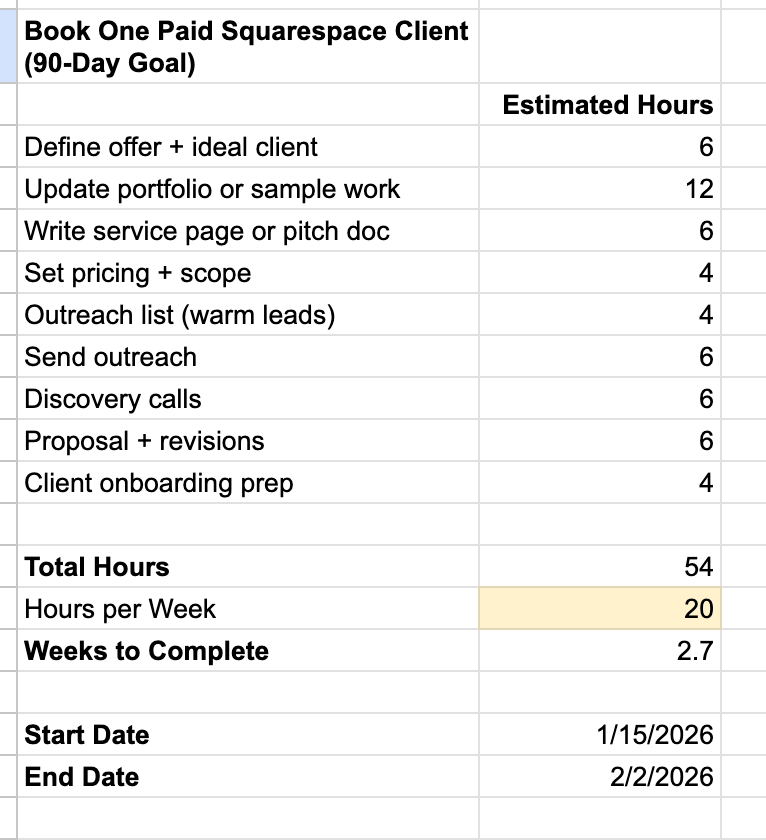
In the “Do the Math” spreadsheet.
Step 1: List Every Task
Open a spreadsheet.
List everything required to finish your goal.
Step 2: Estimate Hours
Next to each task, estimate time. Awareness matters more than precision.
“Under one-hour tasks are easier to start than four-hour tasks. But when I’m designing, I actually work best in four-hour chunks. That’s where I lose momentum if I stop.”
Step 3: Build a Real Timeline
Decide how many hours per week you actually have.
Not your best week. A normal one.
“Once you know your available hours, the timeline becomes real. You’re not negotiating with yourself anymore.”
Step 4: Put It on the Calendar
If it’s not scheduled, it’s just an idea.
“When the time is on my calendar, I stop renegotiating the goal.”
Close
You don’t need more motivation.
You need fewer goals, broken into real steps, placed on a real calendar.
The middle is not something to escape.
It’s something to move through, on purpose.